
How I figured out what my thought was by deciding where it goes

Have you ever experienced a situation where you need to solve a problem, only to remember you have thought of the solution before, but you forgot to capture it?
I have encountered that situation multiple times.
Sometimes an idea comes at an unexpected time. Maybe you are in the middle of a meeting. Maybe you are driving with your hands on the wheel. Either way, that thought is now lost and you need a considerable effort to regain it.
Due to that issue, I tried multiple methods to capture my thoughts better. A voice note for when my hands are tied. A faster app integrated with my system. A frictionless inbox. Anything to get the idea out of my head and stored somewhere safe.
But here is what surprised me.
When I searched my notes later while working on another project, I found that I had already captured the idea I needed. It was sitting there, collecting digital dust as one of the bullet points on my inbox folder. I had never reopened it, never cleaned it up. And when I finally read it, the note was useless, because it was still too raw and I don’t even understand half of what I wrote.
That is when I realized I was obsessing over the wrong problem. Capturing my idea faster or better was not the issue.
Part 2 of a series on building an agent-native workspace. Start with Part 1: The benefit of building Claude a wiki I never saw coming.
The graveyard in my inbox
In my previous essay, I mentioned that I built some sort of personal knowledge management system manually. Part of that system is a capture workflow: I drop my thoughts into a daily inbox file, then later in the day I open it, assess each note, and move it into the correct folder while cleaning it up and adding the missing context. I need to do that in order to make the note useful and relevant. Without it, the note is a piece of thought floating with nothing attached.
But doing that consistently takes discipline. There are times when I forget to do that, and when I remember, I have forgotten the context of why I saved that note in the first place. So I leave it there, hoping one day I would regain the memory of what that note was supposed to do.
It rarely does.
The whole process becomes stuck and over time the inbox becomes a graveyard of ideas. I saved the notes, but I never put them in their right home.
That is when it clicked. It was never about getting notes down faster. Routing the note to the correct place was the real issue. Making that decision is key. I need to classify the notes I capture, and by doing that, I would also uncover what the note really is about and sharpen my thoughts. The act of placing a note is the act of sharpening it.
It sounds obvious once you see it. But it stays invisible due to how much we put emphasis on capturing ideas faster and better.
Four homes for a thought
This is where an agent-native workspace comes in. I run mine on Claude, but the idea isn’t Claude-specific, any capable CLI agent can do the same.
An AI agent would have no issue routing the notes after they are captured. It is relentless. It does not forget or become lazy. But you still need to give it an instruction on how to route them. Think of it as a personal librarian whose job is navigating your knowledge and putting each one on the correct shelf. The librarian is fast and tireless, but it still needs a map of the shelves.
Karpathy’s LLM wiki idea touches on this briefly. He mentioned the existence of index.md as the catalog of every single note you take to help you navigate the wiki. I tried that, and after reading Teresa’s Give Claude Code a Memory, I made an adjustment. I decided that index.md is not enough to navigate the wiki. It is too central and too flat. The agent needs more specific instructions about where the notes should go.
So I set up my workspace to organize and route my thoughts into one of four different destinations based on their classification. Every time the agent ingests a source material, it would need to classify the note as one of these:
- About me
- About a specific project
- About the world
- A rule for the agent itself
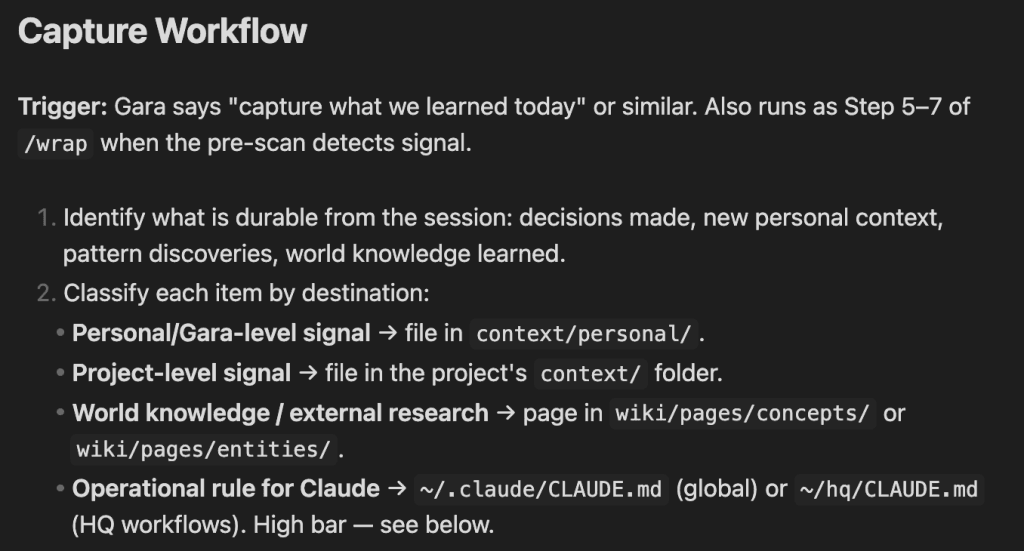
After classifying, the agent would then write a summary to me and wait for my approval before putting the note in the right home while also writing the Personalization Layer. That human-in-the-loop feedback is essential. If you decide to let an agent route your notes, I would strongly recommend keeping yourself in the loop the same way. The agent is fast, but you are the one who knows whether it understood you correctly.
The note that belonged nowhere
One day, I was ingesting one of my notes. It was about a decision I’d been wondering about for quite a while. The note was a consolidation of my research on the topic. After Claude read the note and ran the Quality Filter + Personalization Layer, it proposed a home for the file. It was classified as a note about the world, with reasoning attached.
When I read the summary, I was unsure of whether the note should be classified as personal or world-level signal. It could go either way depending on who I pictured reading it. So I made the decision to put it as a personal-level signal instead. After Claude finished executing, I opened the folder and compared the new note with the others sitting there.
It did not fit.
My personal folder is about who I am and how my agent should work with me. While the note itself is personal in subject, it does not talk about me as an individual. I decided to drop the note completely. It may pass the Quality Filter and Personalization Layer, but when the routing thinking happened, I decided that the note did not deserve a place in the system.
That moment changed something for me. Routing did not just file the idea, it forced a sharper definition of what the folder even meant. It made me realize that the question was never “is this about me or about the world?”. It was “does this define who I am and how my agent should operate with me?“. And based on that axis, the note didn’t cut it.
So by thinking about where to put my notes, I can even sharpen my definition of what is important and worth a place in my workspace.
This is also where the magic of cross-linking comes from. Because we route them at the correct level, the future me and the AI agent are able to trace ideas across projects and surface unexpected connections. Misplacing the note would make it invisible to the agent and it would not make any connection when it should have. The cost of misrouting might even be greater than the cost of not capturing anything at all.
After all, a personal insight buried inside a single project folder is dead. The agent will never see it when I start my next project, and neither will I.
Found exactly when I need it
Running this system, where the AI agent helps and proposes the routing and I adjudicate contested cases, has changed how I work. My notes and ideas are now not sitting idly. The notes will be read and used exactly when I need them. So far, Claude has helped me route 26 world-level notes, 8 personal-level signals, and 50+ project-level signals scattered across multiple projects.
But the impact goes beyond keeping ideas alive. Routing my thoughts into separate spaces also protects Claude against context rot. Context rot is the slow degradation that happens when an agent loads too much irrelevant material into its working context.
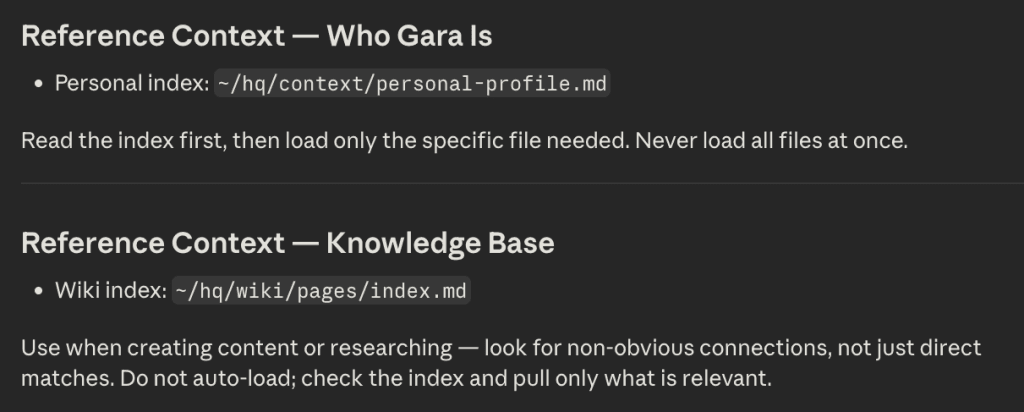
When Claude starts a new session, it will only load relevant files when needed. This lowers token cost, and more importantly, it sharpens the output. Claude does not need to know how I like to code when I am writing a PRD for one of my clients. As Teresa points out in her article, “give Claude exactly what it needs for the task at hand and nothing more”. The routing is exactly what makes her selective loading possible.
Correct routing also makes me move faster and make more grounded decisions. While brainstorming the thesis for this very blog post, Claude pulled from three places at once: my writing philosophy in my personal context, my positioning and content strategy in this blog’s project folder, and my general writing principles in world knowledge. If it finds that the thesis I proposed contradicted the compound knowledge after reading those notes, then it will push back and propose to kill the idea. No matter how good that idea is. That kind of check is only possible if the notes are routed correctly in the first place.
All this time the productivity world has been optimizing the wrong part of note-taking. It was not how you can capture ideas faster or better. The real leverage was deciding where each thought belongs because that decision is also the moment you finally understand what the thought is. That discipline used to be hard. But AI makes it possible as long as I define the routing rules clearly and stay in the loop to handle edge cases and double-check Claude’s work.
My thought was never useless because I failed to capture it. It was useless because once it got captured, I never decided what it was and where it belonged.
This is part of a series on the agent-native workspace. Next: how my AI agents actually fail and why “hallucination” is the wrong word for most of it.