
The benefit of building Claude a wiki I never saw coming

I envy creative people. They always seem to think differently. They are able to see what normal people cannot. This is why I always admire people gifted in art, writing, workers in creative industry, even comedians. They can easily connect random ideas which at first glance do not fit together and produce something tasteful and even thought provoking.
Coming from an engineering background, I always consider myself as more of a rigid and analytical mind instead of an artist. I enjoyed working with clear framework and actionable constraint. When I do my work, even slight ambiguity shivers me to the bone. But after building my agent-native workspace which is a personal wiki Claude maintains for me, it started surfacing links I wouldn’t have seen, and I started to notice what it surfaced. I originally built the system to make the AI smarter and more context aware. What I didn’t expect was it also helps me in another way.
The real failure mode wasn’t a lack of creativity
I often assume creativity as something you naturally have. So I grew up believing I don’t have the creative wiring in me. What is worse is whenever I asked or searched on how to think more creatively, the answers do not satisfy me. “See it from different perspective”, “Look deep inside yourself and reflect”, “You need to force the connection”. I mean.. I get it, but I also don’t. Like how do I even begin to practice the practice?
Say I read a news article about Indonesian fiscal situation. And then open another tab about AI Agents. I then watch a podcast on fitness. I have the raw materials. I have the knowledge I accumulated over the years. But I cannot seem to connect them, to combine threads from different domains and make it into something coherent. Whenever a potential insight could emerge, the moment always slips past me, in a way a more creative or intuitive individual does not.
But I realized it’s not because I don’t have the creative wiring. It’s because of my working memory limit.
I always assumed the fix was to read more books, watch more podcasts, consume more ideas, think harder. But I don’t need to force myself to become creative. I need something to retrieve and externalize my memory and put it in one shared space. Creativity can happen if you put the pieces together in the right place and you see it in the right moment. Epiphany emerges if you throw different components together and watch them mix. Sometimes you do something completely different but then it sparks another idea on your mind. This is what happens when I built my agent-native workspace.
A wiki for the AI
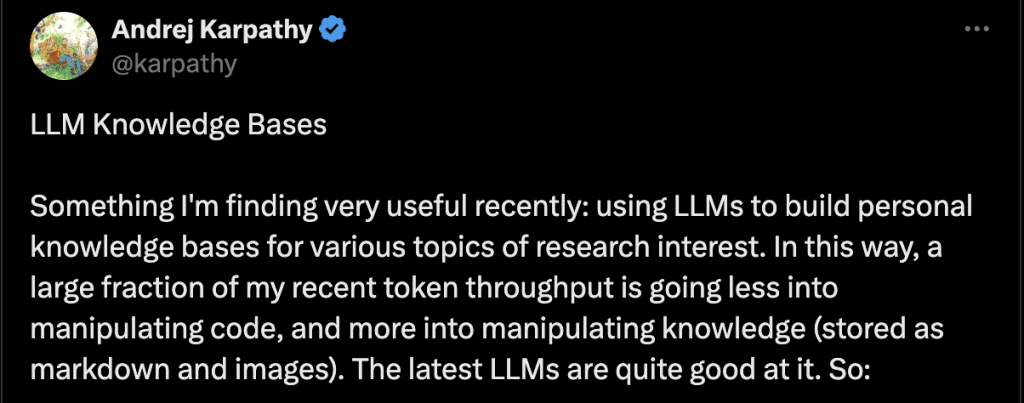
A couple weeks ago, I saw this tweet from Andrej Karpathy. He wrote about creating an LLM wiki. The idea is building a system for the LLM to carry context across sessions. It incrementally builds and maintains a persistent knowledge from raw materials you source, explore, and are interested in. Be it your work PDF, your internal notes, articles you find useful while searching the web. The LLM does the work and it will read, extract key information, and integrate it into your existing wiki.
“The tedious part of maintaining a knowledge base is not the reading or the thinking — it’s the bookkeeping.” — Andrej Karpathy, LLM wiki gist
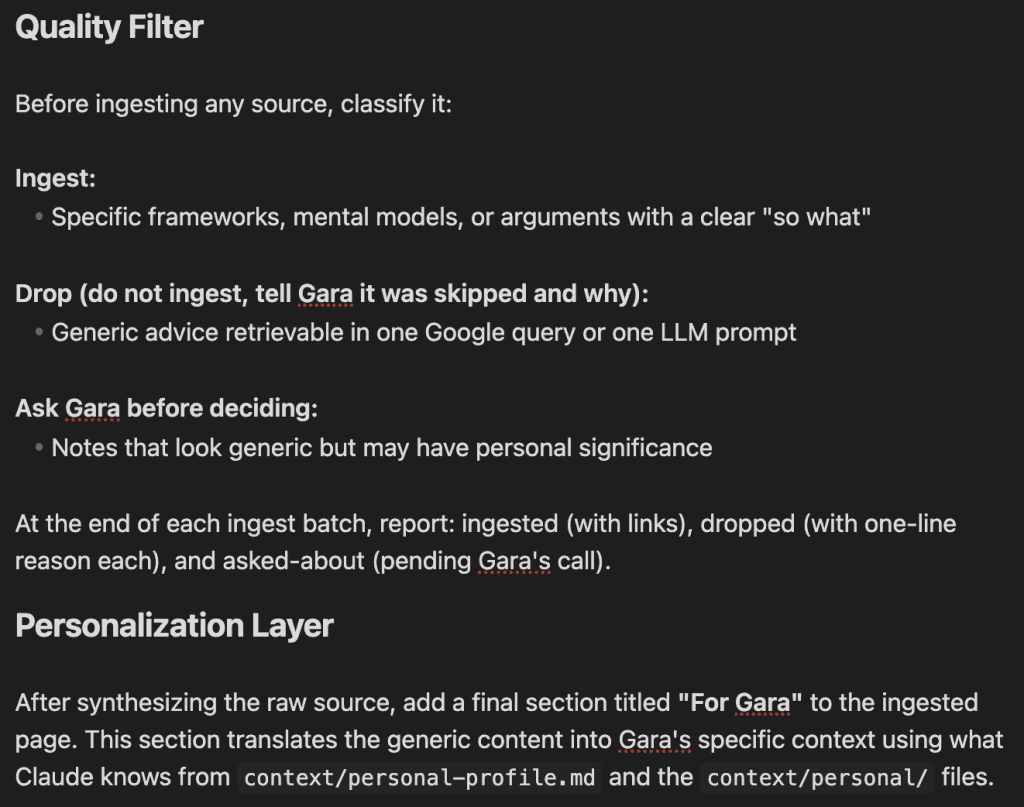
I used this method as one of my inspirations when building my agent-native workspace system, adapting some of his operations for how I use it. My first adaptation is a Quality Filter, so Claude doesn’t ingest generic and textbook explanations. The second is a Personalization Layer. It is a mini section at the end of the note that translates the content into my specific context using what Claude knows from my context files. Together, they keep the wiki lean, and make every note pre-shaped to me before I even open it. I’ll explain both in detail in a later post.
Before Karpathy’s idea, I had built something like this manually. I happened to watch Linking your thinking with Nick Milo and he describes exactly what I want which is a personal knowledge management where you can put notes and link them with one another. As you build your collection of notes and link them together, you can see the connection, the threads that connect the notes together.
There are 2 main problems when I did this manually:
- I couldn’t link notes to something I don’t even have the imagination of linking to. How do I know if this note links with another note beyond the simplest and most obvious connection. I understand if a note mentions Elon Musk, then yes I would have linked it to a note about Tesla. If a note mentions something about America, then I would link it to a note about Hollywood. Beyond that, I would have no clue.
- Efficiency. I used to expend a considerable amount of my time bookkeeping and linking these notes. Over time, I became lazy and stopped linking it altogether let alone bookkeeping it. I have piles of notes sitting there without a follow up. Eventually they became trash in my vault.
So I was interested when reading Karpathy’s LLM wiki idea. It never occurred to me to have AI help me bookkeeping and linking my notes. Now collecting and sourcing notes becomes fun again. Because I know the LLM would read and extract key info for me and cross link it automatically with other notes. It covers the tedious part I become lazy of. And every time I ask a question, it always knows the answer and generates a response based on the compounding knowledge it has.
I hadn’t realized there was another benefit until I started reading the wiki myself.
One Friday morning
On Friday morning, I was at my desk reading the weekly news briefing I automated using Claude. One of the news items was about Atlassian producing a survey report called State of Product 2026. I was interested in the whole report, so I downloaded the raw file and had Claude ingest the report.
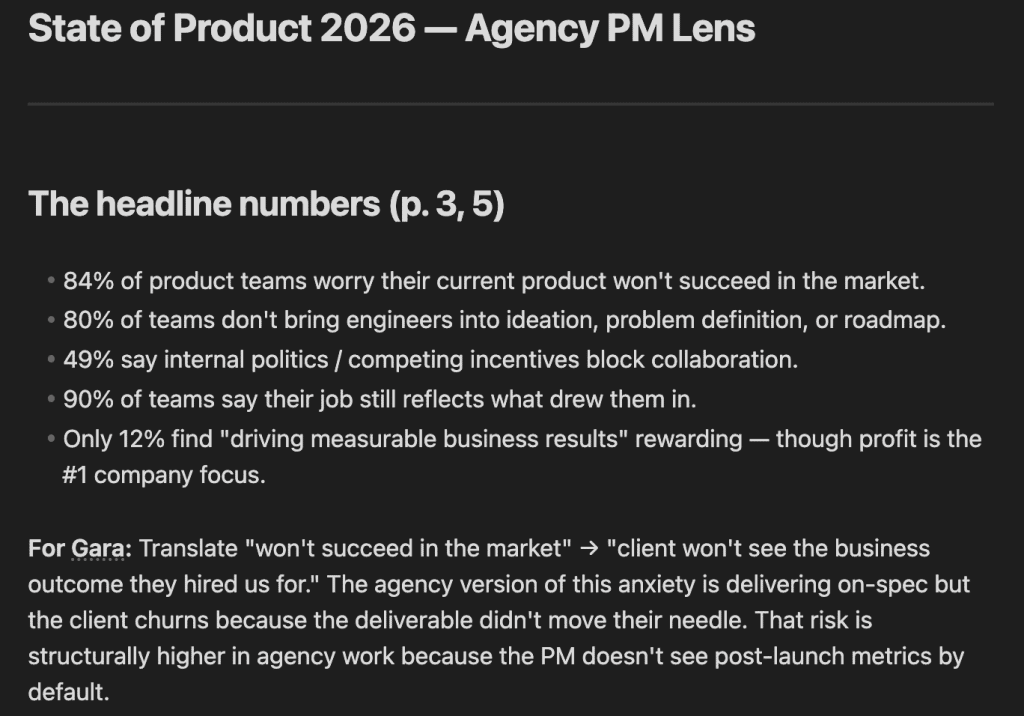
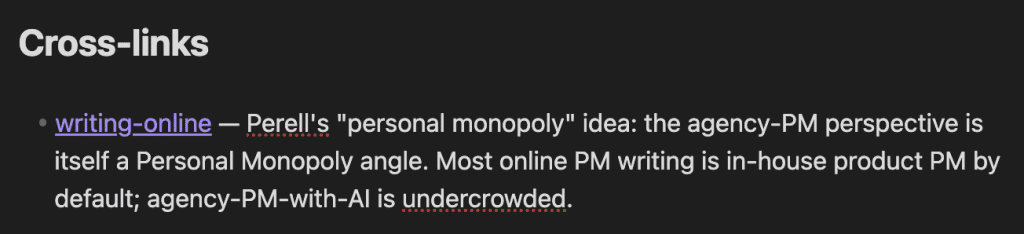
It is a survey showing what product teams have on their shoulders and sharing some knowledge on how product teams can work better. While reading the wiki, I found Claude cross linked this note to my writing online note, which is a note about building Personal Monopoly through writing online by David Perell. A note I ingested weeks earlier. This is the idea behind the Quality Filter and Personalization Layer mechanism. The survey wasn’t ingested as a generic summarization of the PM report. It changes and translates the content, filtered to what matters to me and how it applies to my work. That is why it could collide with the Perell note.
Those 2 notes talked about 2 different domains which are PM strategy and writing. After reading it, it triggered me to have a conversation with Claude about how to position my blog. The note then became the foundational thought process Claude and I went through. We then tried to come up with a strategy to position ourselves by filling the gap mentioned by the survey and turn it into an online essay about AI builder-practitioner. This wouldn’t have crossed my mind. This is how the active cross linking works, it surfaces connection during synthesis and manages to detect dots I don’t notice because of my limited working memory and creative wiring. This post you’re reading, dear reader, is the proof the mechanism works.
The reason reading the wiki produces connections and ideas to me is not only because the wiki exists. Every note is pointing to me and shaped to my context. It meets me halfway, and all I have to do is pick it up from there. No more filler. Everything is essential. That is how the connection becomes easier, the absorption is faster, and the ideas flow like I’ve never experienced before.
All this time I thought the biggest benefit of using AI was helping me do my tasks, but what I found instead is AI helps me see what I couldn’t see before.
This is part 1 of a series on how I built the agent-native workspace to run and organize my everyday life.